

When I become frustrated that Quakers are not more knowledgeable and concerned about our settler colonization of this land, I remind myself that I was ignorant of much of this until a short time ago (around 2017).
I did not know. Looking back now, I wonder WHY I didn’t know.
tom kunesh’s challenge
tom kunesh, an Indigenous Quaker, wrote about this in 2022.
I have been looking for a sign that quakers in the USA recognized and opposed the oppression that comes with colonialism. All indications prior to 2010 are to the contrary: as settlers originating from Europe, quakers enjoyed the military peace and occupation of Turtle Island by England and other european nations. “Friends” profited from colonial expropriation of indigenous people’s land and resources.
kunesh, tom (2022) “Decolonizing Quaker Moves to Innocence: What Would it Take to Decolonize the “Quaker Peace Testimony”?,” Quaker Religious Thought: Vol. 139, Article 5. Available at: https://digitalcommons.georgefox.edu/qrt/vol139/iss1/5
Entirely Different Boarding Schools
I found it ironic when I realized the Quaker boarding high school I graduated from in 1970, Scattergood Friends School and Farm, was established (1890), at the same time Quakers and others were involved in establishing some of the Indian boarding schools.
Both were residential institutions designed to mold young people in specific ways. For Quakers, the goal was to help students grow in their understanding of Quakers and our role in the world. This was sometimes referred to as a “guarded” education intended to minimize the broader, secular culture’s influence on us. Based, in fact, on developing critical thinking skills to serve as the tools to resist such assimilation for the rest of our lives.
This is then head of school, Thomas Weber, introducing Paula Palmer’s talk about the Quaker Indian Boarding Schools, at Scattergood Friends (boarding) School, July, 2019.
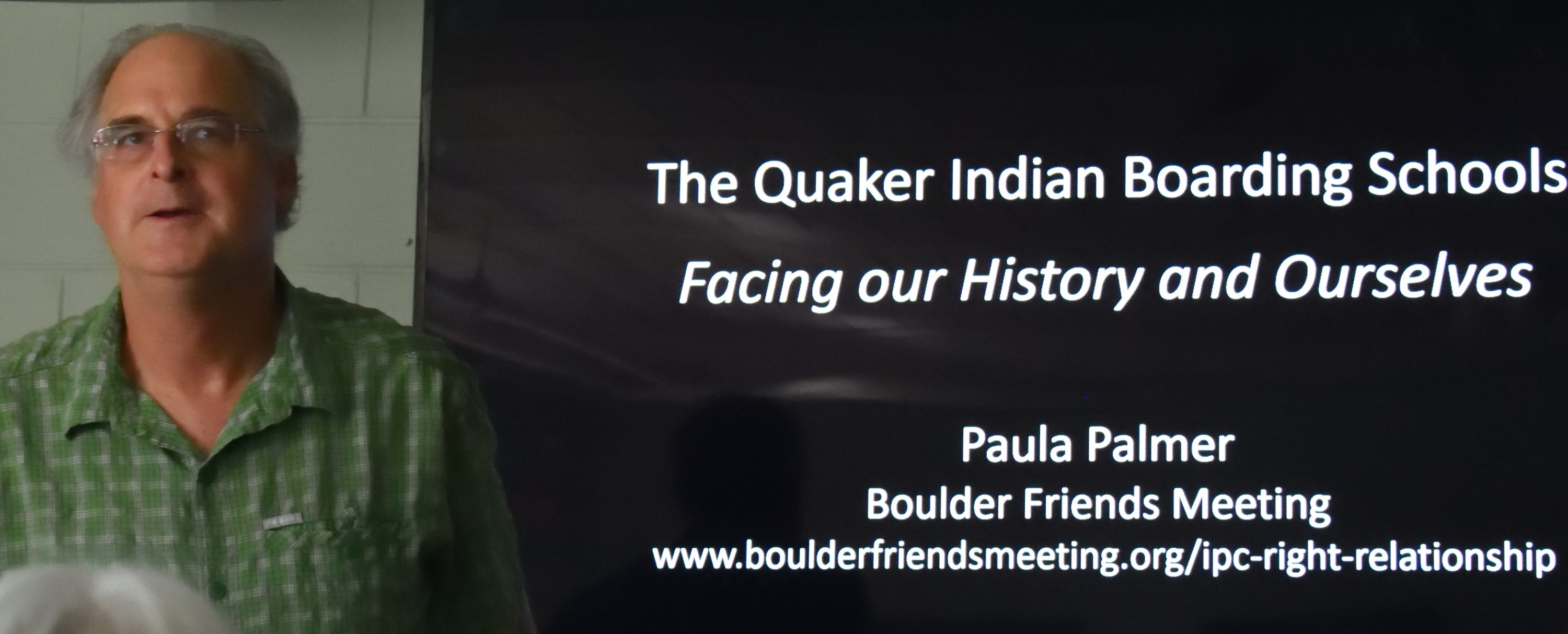
Indian Boarding Schools
The opposite was true of the Indian boarding schools, as they were referred to. The goal was forced assimilation into the encroaching culture of the European settlers. The goal, according to Captain Richard Henry Pratt's speech (in 1892) in which he used the now well-known phrase to describe his philosophy of assimilation was: "Kill the Indian in him, and save the man."
It is horrific that native children were torn away from their families. Many subsequently died from disease brought by the settlers, from exposure when they tried to escape, or from physical abuse. These schools were often hundreds of miles away from their tribe.
The reported discovery of children's remains found in May, 2021, at the Kamloops residential school in British Columbia, provoked a widespread international outcry. And investigations at other residential schools.
In the summer of 2017 my Quaker yearly meeting, Iowa Yearly Meeting (Conservative) held a panel discussion about building bridges with Native peoples. This was first time I heard Sikowis (Christine) Nobiss speak. Over the intervening years we’ve done a lot of work together, me in a supporting role. And our friendship has grown.
First Nation-Farmer Climate Unity March
In 2018 we were both part of the First Nation-Farmer Climate Unity March that she organized with Ed Fallon. The purpose was for a small group of Native and non-Native people to spend eight days walking and camping together from Des Moines to Fort Dodge, Iowa, ninety-four miles, along the path of the Dakota Access Pipeline. The intention was for the group to get to know each other by sharing stories as we walked. That worked brilliantly, and various combinations of us have worked on many things together since.
At that time I was profoundly ignorant about settler-colonialism and the Indian boarding schools. I remember wondering how that history affected the Native people I was walking with. Perhaps my most ignorant thought was wondering whether the Native people on the march knew this history. Whether they had personally been affected. Knew of the Quaker involvement. Would they be judging me because of this history? Should I bring it up? Apologize?
Sadly, I am now very familiar with the deep multigenerational trauma that every Native person in this land and Canada lives with even now.
Why Didn’t I Know?
I didn’t know about this earlier, because no one taught me. As tom kunesh said above, there was silence from Quakers about this.