

I’ve been surprised by the role Scattergood Friends School and Farm is playing in my most recent work related to the Great Plains Action Society’s Indigenous-led Urban Resilience Hub in Iowa City.
I was glad to see that Scattergood offered lodging for those of us coming to work at the Hub. Sikowis Nobiss, founder of the Great Plains Action Society, had been in touch with the School before I became involved. Plans were being discussed regarding ways students could be engaged with the Hub.
Another Bear Creek meeting member, and my roommate when we attended Scattergood, Jon Tesdell, and I stayed at Scattergood during the work weeks at the Hub. We talked about our Hub work over meals at Scattergood.
While I was at the School during the first Hub work week in December, I was glad for the chance to talk to the students about the work at the Hub during a community meeting. Being at the School during subsequent work weeks offered more opportunities to talk with the students.
Jon and I had numerous informal conversations with our new friends at the Hub about Scattergood. When asked where we were staying, for example, we talked about the School. Unsurprisingly, many people at the Hub know something about the School because of the many ways it is involved in work of the wider community. Sikowis spoke about building bridges with Native peoples at Scattergood in 2017.
Scattergood prepared me for the Hub work in ways I'm only now seeing clearly.
We learned about communities of integrity through how the School ran itself. We learned about personal integrity from the examples of our teachers, and the history of Quaker work for peace and justice. We attended Quaker meetings for worship in the Hickory Grove meetinghouse on the School campus. We learned about the land from our work crews on the farm and in the orchard.
I began to see the throughlines from what I learned at Scattergood converging again.
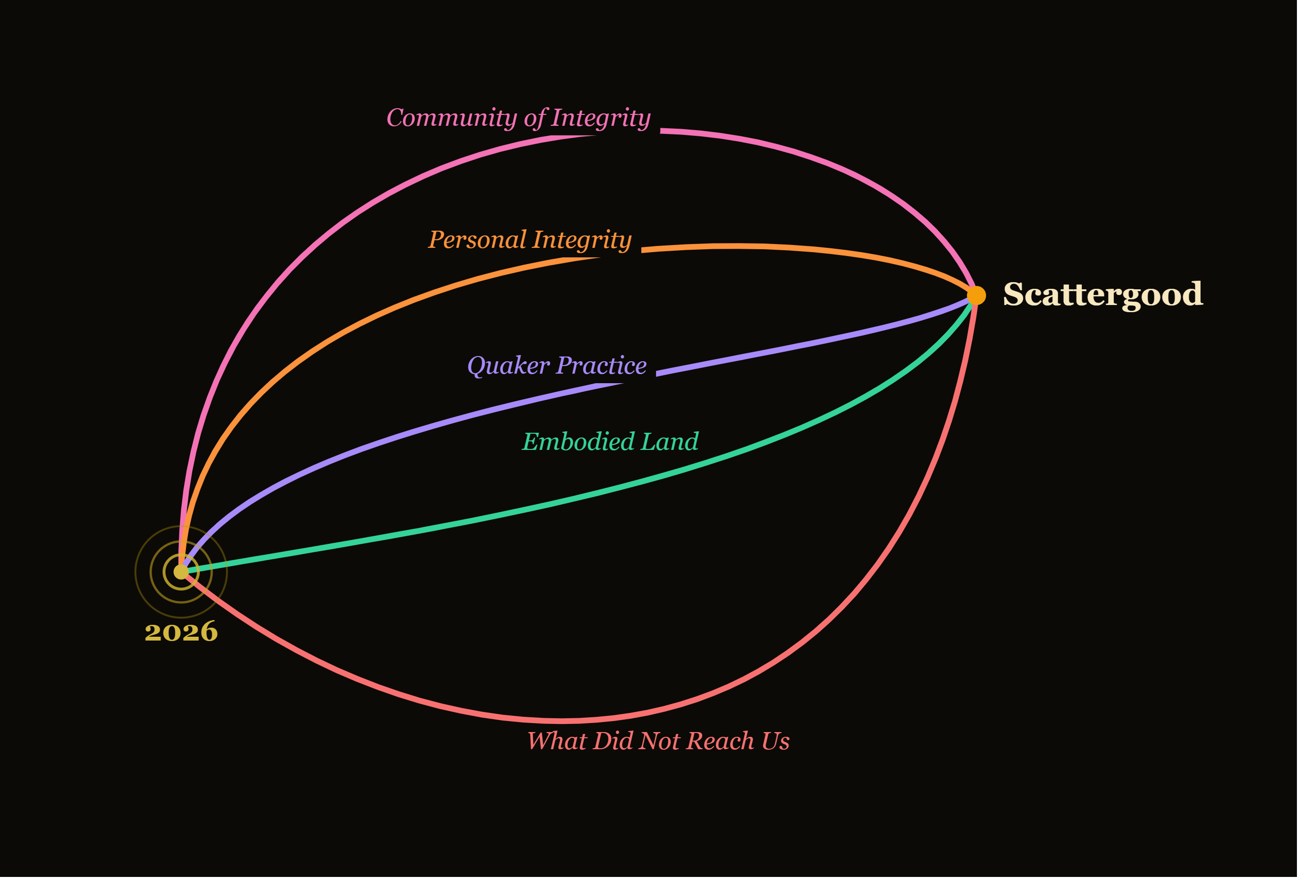
There was one exception to what we were taught. That being the history of Quaker involvement in settler-colonialism, including with the Indian Boarding Schools. This is the glaring issue I’m being confronted with, and the root of my struggle with Quaker complicity in colonialism.
I call this arc “what did not reach us.” Instead of something like “what was hidden from us.” Because I do not believe our teachers at Scattergood were instructed to not teach us this history. I believe they didn’t know much of this history themselves.
I did not know much of this myself. I was in the class of 1970. It is ironic that Scattergood was established in 1890, at the same time Quakers were also establishing Indian boarding schools.
I only remember one conversation about this when I was a child. I was told some Quakers went to those schools to help the Native children.