How Knowledge Travels
Why did knowledge about Quakers and Native Americans not reach us?

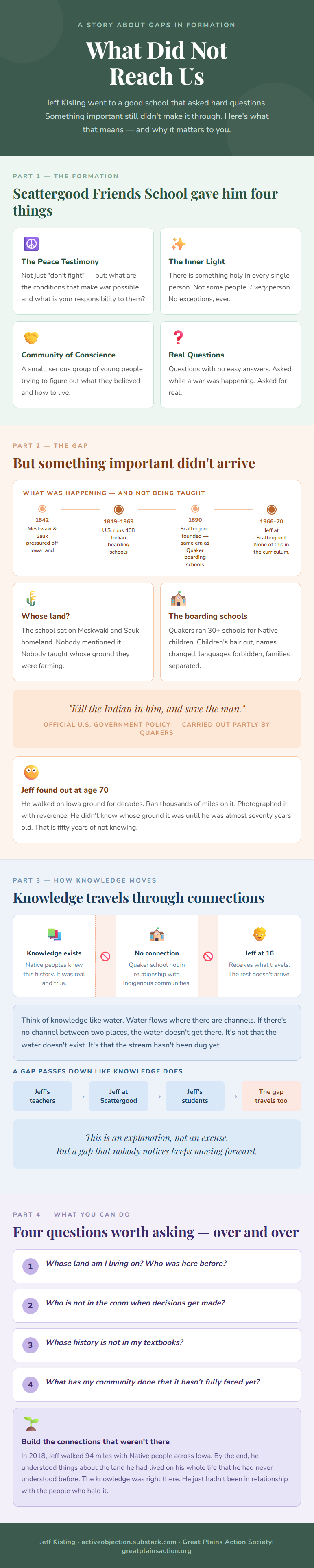
Working through the throughlines of my life, I found one I hadn’t expected: What Did Not Reach Us. That is a statement, not a question.
In naming this path, I considered several possibilities. Some framed it as an intentional cover-up of the Quaker history of settler-colonialism. But that isn’t what happened at Scattergood Friends School, where I graduated in 1970. Our teachers, I believe, knew little about this history or its consequences themselves. At the time there was little public awareness of the tragedies of forced assimilation of Native children. Indigenous communities and historians were well aware. Quakers, however, did not then have the relationships with Native peoples that would have taught them these things.
There was a public awakening when what appear to be the remains of Native children began to be discovered on the grounds of those institutions of forced assimilation. That discovery deepened a growing awareness of the injustices of settler-colonialism that continues today.
This is a story about people whose good intentions were shaped by assumptions they could not see, operating within a colonial system that presented them with only certain choices and certain ways of understanding what they were doing.
As discussed below, knowledge can be thought of as water flowing through channels. Water doesn't reach where there are no channels — not because the water isn't there, but because the channel hasn't been built. That is what what did not reach us means.
What is called for now is building the connections that weren't there before. Engaging with the work of the Great Plains Action Society (GPAS) is one way to begin. Those connections go back to 2017, when Sikowis Nobiss — founder of the GPAS — spoke at the annual sessions of Iowa Yearly Meeting (Conservative) (IYM(C)) about building bridges with Native Americans. IYM(C) members have since participated in work weeks at the GPAS's Urban Resilience and Innovation Hub in downtown Iowa City. Friends can also support this work by attending the monthly online meetings of the Decolonial Repair Network (DRN), which was created specifically as a way for allies to support GPAS. I help maintain the DRN website: https://decolonialrepairnetwork.blog/